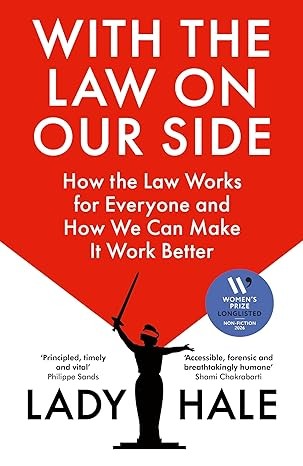

With The Law on Our Side: Lady Hale on Why We Must Stand Up For Our Legal System
February 16, 2026
An article by Jonathan Walker-Kane.
The doors of the Royal Courts of Justice swing open and so begins our journey through the legal system with a most distinguished and informative guide, former President of the Supreme Court of the United Kingdom, Lady Hale. At every page turn, this book compels readers to think carefully about the system that stands before us.
This book proffers a strong case for the legal system and why we must fight for it, even as it crumbles due to lack of funding, unprecedented opposition, as well as a relentless retention and recruitment crisis. Indeed, Lady Hale introduces it by outlining the importance of “both” the law and a justice system to solve constantly evolving challenges in society. She rightly asserts that Parliament’s legislative efforts must be met with the “machinery necessary to make them work.” Lady Hale makes a particular point to highlight that the justice system, in its entirety, shares the difficulties which have featured in headlines about the criminal justice system.
“Courts are for Everyone”, part one proudly proclaims. Lady Hale’s ability to seamlessly intertwine procedural and historical context renders the text accessible to those who have not had the opportunity to spend long periods of time getting to grips with the law. By breaking down barriers of understanding, whilst also pointing out other lingering barriers in the justice system, such as continued accessibility issues with older court buildings, this book takes on a practical approach to assessing and identifying what it means for courts to be for everyone.
In the process of writing this book, Lady Hale visits “two different kinds of tribunals, two family courts, a magistrate court, and two Crown Courts, as well as the High Court and the Court of Appeal.” Peppered throughout Lady Hale’s narration of the goings on in different court buildings, is frank commentary on the impacts of policy on the practical running of the legal system. One such example being what she describes as the “false economy” created by cuts to legal aid in 2013, which have resulted in a larger number of cases being taken to court due to a reduction of financial support at earlier stages of difficulty or dispute.
Lady Hale’s contributions to family law are particularly significant, the chapter dedicated to the family court was therefore received with particular interest. The chapter opens with a description of a “lovely summer day,” where she spends the day observing the Family Court on High Holborn. Following that, Lady Hale offers an introduction which outlines many of the questions and considerations that arise in family law cases. This style of writing, employed throughout the book, is one which invites the reader to consider their own opinions and perceptions of legal dilemmas which often have “no-hard-and-fast rules,” or “easy answers.” In fact, one of the things which this book does best is humanise the legal system. When retelling cases which she observed, a concerted effort is made to present claimants, victims, defendants, barristers, judges, and court staff as human beings. Perhaps it was this very acknowledgment of humanity which informed many of Lady Hale’s influential legal judgments.
After thorough exploration of the courts in the first part of the book, Lady Hale moves on to discuss rights in the second section of the book: “Rights are for Everyone.” Complex and heavy though the law may be, this book benefits from the wit and humour of its author, which is coupled with a clear and interesting approach to discussing rights. Perhaps a call back to Lady Hale’s previous career in teaching, cases are outlined with the legal issues enumerated, followed by an invitation for the reader to consider independently, before analysis of the outcome.
Most interestingly, unlike the judgments which are available as part of the public record, this book offers a backstage pass to the process of deliberation, as well as the process of reflection following the publishing of a judgment. One such case, found in the chapter on the rights of children at school, is R (on the application of Williamson) v SofS Education and Employment UKHL 15 [2005] 2 AC 246.This was a case in the House of Lords seeking to determine whether interference with the genuinely held religious beliefs about corporal punishment (by parents and teachers at a Christian school) could be justifiably interfered with on the basis that this prohibition sought to protect the rights, freedom, and the welfare of children. Here Lady Hale suggests that there is a “curiosity” in the case caused by the fact that “practice of corporal punishment involves what would otherwise be an assault upon another person.” This renders the question in the case as one which ask whether the prohibition of corporal punishment achieves a fair balance not only for the children at the faith school, “but also of any other children who might be affected by the persistence of corporal punishment in some schools.”
Section two of the book discusses many other rights, in addition to those of school children, this includes the rights of LGBTQ+ people, workers, patients, and disabled people. The thirteenth chapter of the book is dedicated to discussing women’s rights. Refreshingly this book achieves a balance between acknowledging progress whilst also highlighting where necessary improvements must be made. It is easy to get caught discussing only the failings in the law and legal system. As it relates to the rights of women, Lady Hale reminds us that whist efforts to achieve equality have made great progress, “the fight is by no means over”. This is brought to life by a discussion on the disputes on equal pay in the case of North and others (Appellants) v Dumfries and Galloway Council (Respondent) (Scotland) [2013] UKSC 45.
Another dispute is presented through the landmark case of White v White [2001] 1 AC 596. A case relating to the division of a husband and wife’s property, in particular farmland, following divorce. The book, written before the most recent Supreme Court judgment in Standish v Standish [2025] UKSC 26, acknowledges the other landmark decisions in matrimonial finance law by the House of Lords: Miller v Miller and McFarlane v McFarlane [2006] UKHL 2 AC 618, cases which Lady Hale too had presided over in the House of Lords.
In the final part of the book titled “making the law for everyone” the complex processes of creating law in all three branches of government is discussed. It is a brilliant description of the many ways which law is created whether in parliament, government, or through the courts. It is in this chapter that Lady Hale revisits the Supreme Court of the United Kingdom, which she describes as a “beautiful, friendly and welcoming place, open to all, but where serious work could be done.” Being the final court of appeal in the United Kingdom, the Supreme Court indeed undertakes very serious work and has made significant declarations and judgments on the law, a process which Lady Hale assures us is not taken lightly.
This book ends with a particularly important reminder: “the power of each and every one of us- to understand how much the law means to each and every one of us- how the law and justice system are indeed on our side, and how we must stand up for it.” Excellently written and thought-provoking, this book from start to finish, empowers readers to understand the legal system and perhaps, even hopefully, work towards the preservation and betterment of such a vital resource.
Jonathan Walker-Kane with Hadeal Abdelatti [Hadeal was, like Lady Hale, at Girton College.]